Monday, 19 November 2012

Pie Doughs and Piping

A new class, a new Chef, a new baking lab, and new rules. Along with the excitement of a new curriculum comes the fear of the unknown. Our Fundamentals I Chef visited us while we were in Fundamentals II and he had , well, a strict first impression. Turns out he is not so much strict as he is very keen on cleanliness and professionalism.

We started this class with learning about pie doughs. Perhaps you knew, but I didn't really think about the possibility of having different types of pie doughs. The two we focused on were flakey and mealy. Flakey is best for the tops of pies as they have that delightful and sought-after flakiness you see in commercials on the tele when a fork cuts into a slice of pie. But as wonderfully delicious and layered as that dough is, it is horrible as a bottom crust for fillings that have a lot of moisture. It runs the risk of suffering from sog-itus. In the case of moisture-rich fillings, like pumpkin pie, a mealy dough is best. Mealy crusts are still tender and crisp, but they bake up short, meaning they don't have the same layering that flakey dough has. Both very tasty, just better for one job than the other.

Getting ready to cut in the shortening

Unfortunately, you can't see the "marbling" created by the fat and the flour in this picture, but flakey dough should have more visible and larger pieces of fat than mealy. Flakey dough fat should be cut in until the pieces are about the size of peas while mealy should resemble course cornmeal.

Flakey dough

The format of this class is a bit different. In Fundamentals II, our Chef demonstrated all the products we would be making in three days. That made for some very tired feet after standing for 4 hours straight, no breaks. This time around, the Chef demonstrates a product, then we all make it before moving onto the next. The pace of the class feels faster as a result, but it also helps to smooth out kinks and feels much more interactive. Plus, we're less likely to forget important steps and tips as we get to try things out right away. :P

Making chocolate shavings

In the second half of the class, we practiced piping a shell border. We traced circles from 6-inch cake rings, the same size of cake we'll be making for this class. If we had time, we could try writing Happy Birthday inside the borders with chocolate.

Ending borders neatly is hard

We put our pie doughs into the fridge to relax and chill overnight. It is key to let pie dough rest in the fridge for two main reasons 1) allows the fat to firm up and not melt into the dough and 2) lets the gluten in the dough relax so the pie shell doesn't shrink while baking.

Tomorrow we will be making pumpkin pies, apples pies, and lemon meringue pies. If you're around, you can pick one up at the Marketplace on Wednesday (we finish too late in the day to put them up for sale the same day).

One more thing! The next group of students in the Customer Relationship Management class is hosting their bake sale this Thursday and Friday. Here's a sneak peak at one of their cute offerings. Definitely try to check it out!

Winter Wonderland theme

Saturday, 17 November 2012

Tarts Day 4 & Test


Right at the start of day 4, we split all the up and set to work. I was incharge of the French apple tarts and with helping V finish the baked chocolate ganache tarts.

Baking in a Miwe deck oven
Uh oh! Custard leakage on the lower left

Here is V making the feathered design on the ganache tarts with a knife.

Making it pretty

More linzer tarts! We decided to only garnish them with one chocolate piece as opposed to two because the last ones were too tall.


The following day was our last day in Pastry Fundamentals II and also our last test. Right away we switched on the ovens and pulled out our linzer and chocolate tart shells. The chocolate tart shells are best baked when at room temperature as opposed to the other tart shells which should be baked when cold. We had a very sad incident when several chocolate tarts had air bubbles trapped underneath them and the expansion of the air in the oven caused the tarts to bubble and bake up ugly and unevenly. Four out of seven tarts had to be thrown out! :(

Putting the lattice on my linzer

We had lots of extra linzer dough left over so V and I made some linzer sable (cookies) while waiting for our tarts to bake. So good!

This batch was a bit burnt
Like mini versions of the tart!
Here are my finished tarts! I messed up the feathering for the ganache tart. :( I also was not satisfied with the glazing of my fruit tart. The apricot glaze which we used kept clumping while I was using it, resulting in areas with too much glaze and areas with not enough. Apricot glaze is essentially apricot jam. It is often used to coat fruit tarts to help delay the browning of fruits and to make it shine. It's also tasty!


I still did very well and the Chef told me ways to improve so I didn't feel as frustrated as I did with the choux paste taste. Sometimes I am very hard on myself when I don't perform as well as I want to, but I just have to keep reminding myself that I am here to learn and mistakes are expected. 

And that was the end of a very fun class! There were pros and cons with working in a group and while it was fun overall, I have to admit I'm also looking forward to working alone. That will really reveal my strengths and weaknesses. No hiding! What do I say that?

Bring it! >:D

Wednesday, 14 November 2012

Tarts Day 2&3, Disaster Days

Yesterday was one of those days. The ones where no matter how hard you try, things just don't work the way you want them to - disaster days.

I was in charge of the baked chocolate ganache tarts. It is the easiest of the tarts to make - simply bake the tart shells, melt some chocolate in milk and cream, fill the cooled shells, and bake again. Nope! My first mistake was despite the instructions in the book, I was not supposed to blind bake the chocolate tart shells. The Chef caught me early so I pulled the shells out and let them cool. I then had to go back and patch the sides of the shells. The pre-mature baking caused the sides of some of the shells to shrink or slump inwards. Next up, the filling! I didn't make a mistake, but I did do some things backwards. By backwards, I mean that instead of pouring the hot milk and cream into the chocolate, I was trying to dump the chocolate into the hot milk and cream. Did I mention the milk and cream was hot? Splashing hot liquids is not so cool, literally!

Despite the disasters, they still turned out tasty!

While I was struggling with the ganache tarts, my team forged ahead with their tasks and started on their fruit tarts. By the time I got around to my fruit tarts, we had run out of apricots and kiwis. Too bad for me, no more kiwis. : ( I had to make a special trip to the food store in the next building to grab a flat of apricots, which pushed me farther behind schedule.

Beginnings of a fruit tart

However! Team work to the rescue! V got the rest of my fruit ready for me, made sure I had apricot glaze (to finish the tart), and cleaned up after me! I simply cannot send her enough hearts. :)

When it finally came to the last stretch (final decorations), our whole team pulled together and pounded out the tarts. : )

Linzer tart filled with raspberry jam

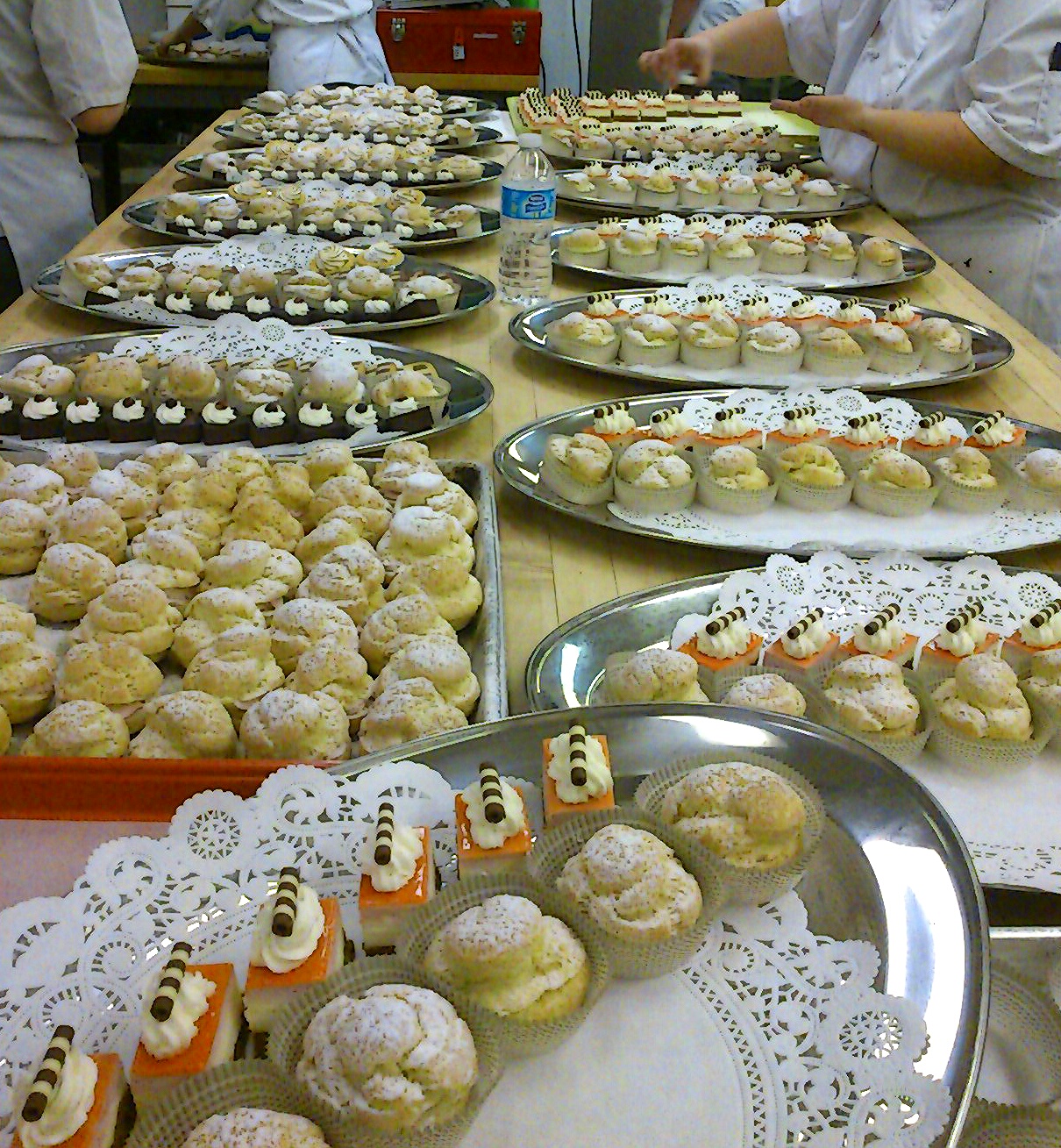
We even had some time leftover to help the Chef with some preparations for a special event taking place tonight. Silver platters were lined with lemon meringue tartlettes, brownies, cold cheesecakes, cream puffs, and spritz cookies.


Today went much better than yesterday. Back to day 1 tasks, we started the day with unbaked ganache tartlettes and lemon meringue tartlettes. As I made the unbaked ganache before, today I made the lemon meringue tartlettes.

Filling tartlettes for lemon meringue
V piping out meringue
Leaf colored white chocolate garnishes

While I busied myself with the lemon filling and V made the unbaked ganache, S and D worked on rolling out tart doughs. This is our last week in Pastry Fundamentals II so the Chef pulled out all the tart dough and told us to roll it all out that had been leftover from previous groups. He also asked us to roll some cookie dough out into tart pans. Holy roly poly! Mountains of dough!

This was only half
A mix of chocolate sable, short dough, and linzer tart
dough - it looks like the milky way

We ended up with 10 chocolate ganache tarts, and 5 each of fruit tart and apple custard tart shells and several linzer tart shells. This was on top of the 2 chocolate ganache, one fruit tart, one apple custard, and two linzer tart shells per team member per our regular production. V had to multiply the baked chocolate ganache filling by 14 to accommodate all the shells.

The biggest bowl in the lab

I can feel the atmosphere of the class winding down. Up next is Pastry Fundamentals I, which focuses on cakes and pies. Despite the numbering, Fundamentals I is not a foundation for Fundamentals II. :P

The Chef for that class came into our class and gave us each a packet of recipes, schedules, and gradings for us to study. Just from looking at the schedule, this class looks like it is going to be tough. While Fundamentals II has been a lot of fun, I have always felt the grading was too lenient. Not only is Fundamentals I focused on individual work (no more groups), the grading scale looks much more strict. It seems a bit intimidating, but at the same time, I am very excited. We'll learn to work with fondant, lots of piping, and remember those marzipan fruit from the Movember Bake Sale? We'll learn to make those too!

Pastry Fundamentals I? Bring it on!